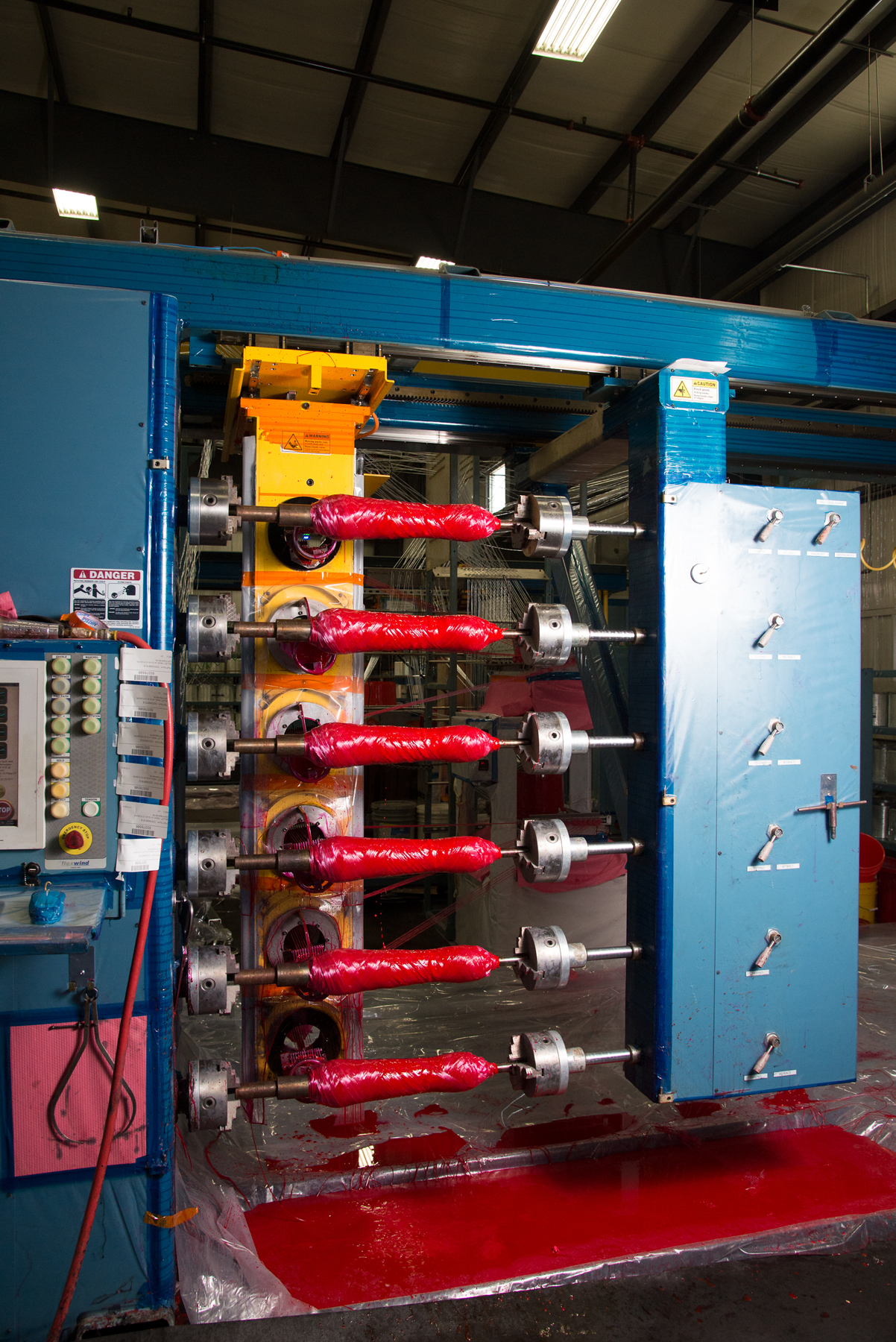
Filament winding is a highly automated composite manufacturing process that delivers precision, performance, and efficiency. Unlike hand layup or other molding techniques, filament winding controls fiber placement under tension, allowing for optimized strength-to-weight ratios and repeatable results.
Consistency: Automated winding ensures precise fiber orientation and uniform resin distribution, minimizing defects and variability.
Efficiency: High production rates with minimal waste make filament winding ideal for cost-effective manufacturing of cylindrical and spherical parts.
Performance: Fibers are placed under controlled tension, aligning them along primary load paths. This maximizes tensile and hoop strength, stiffness, and pressure containment capabilities.
Design Flexibility: Winding patterns can be tailored (hoop, helical, polar) to achieve specific mechanical properties and withstand complex load cases.
Scalability: Suited for both prototypes and full-scale production, filament winding supports aerospace, energy, defense, and industrial applications requiring structural reliability.
Durability: The process produces components with excellent fatigue resistance, chemical compatibility, and long-term structural integrity.
At GP&C, filament winding enables us to engineer high-performance solutions for demanding environments—precision in every fiber, every time.